 1711 Henrietta Johnston (1674-1729) Henriette Charlotte de Chastaigner (Mrs Nathaniel Broughton)
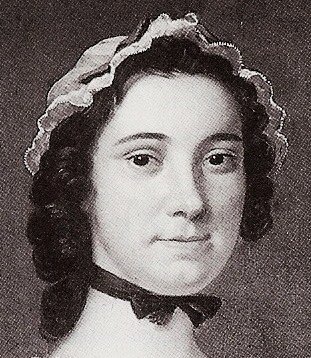
 Early in the 18th century, many of the portraits of colonial gentle ladies posted on this blog were done by Henrietta Johnston (1675-1729). She was the first identified pastelist & female portrait painter in the American colonies.
 1705 Henrietta Johnston (1674-1729). Young Irish Girl.
 At the age of 10 or 12, Henrietta de Beaulieu, fled with her Huguenot family to England from France to avoid persecution. In 1694, she married Robert Dering (1669-1702-4),the fifth son of Sir Edward Dering, and moved to Ireland. Their marriage application dated March 23, 1694, describes Henrietta as a maiden, about twenty, of the Parish of St. Martin-in-the-Fields.
 1705 Henrietta Johnston (1674-1729). Unknown Dublin Lady in Grey Dress.
 When she was in Ireland, two Irish artists were doing pastel portraits, Edmund Ashfield (d. 1700) & Edward Luttrell, who flourished from 1699 to 1720. Pastels were a relatively new medium at the time. It is possible that she met or even learned from these men, who may have trained in France where the pastels originated. Typical of portraits of the period, her paintings resemble in pose & format, but not medium, the work of Sir Godfrey Kneller.
 1708-09 Henrietta Johnston (1674-1729). Unknown Lady.
 Her earliest identified extant works are from about 1704 Ireland. She was a single mother at this time, for she remarried the following year. When her first husband Dering died, she became a widow with two daughters, one of whom, Mary, later became a lady in waiting for the daughters of George II. The pastel portraits she painted during this period were mostly of members of deceased husband’s extended family, which included the Earl of Barrymore & Sir John Percival, Earl of Egmont.
 1708-10 Henrietta Johnston (1674-1729). Marianne Fleur Du Gue (Mrs Pierre Bacot)
 In 1705, she wed the Reverend Mr. Gideon Johnston (1668-1716), a graduate of Trinity College, Dublin, who was the widowed vicar at Castlemore & who was to become rector appointed by the Bishop of London, of St. Philip’s Church in Charles Town, South Carolina, in 1708.
Charleston was a fledgling town at this time scrambling to become become the most affluent & largest city in the South, the leading port & trading center for the southern colonies. Many French Protestant Huguenots, seeking religious freedom, were moving to Charleston, where they began building fine townhouses along the harbor's edge & wanted portraits to grace their hallways & establish their family's presence as a power.
 1708 Henrietta Johnston (1674-1729). Mary DuBose (Mrs Samuel Wragg)
 Henrietta, her new husband, & 3 children from their combined family set sail for his assignment in Charleston. The story goes that on a ship stopover in the Madeira Islands, the groom went ashore, returning after the ship had already sailed for Charleston. Henrietta landed with her children in tow only to discover that the parishioners had appointed their own rector while waiting for the Bishop's appointee. There was no pulpit or parsonage for the new family.
 1710 Henrietta Johnston (1674-1729). Catherine LeNoble (Mrs Robert Taylor)
 When Johnston finally arrived in Charleston 12 days later, he had to oust the elected rector from his pulpit. This was not a popular move, & Gideon Johnston became bogged down in church politics. He wrote in September, 1708, that he "never repented so much of anything, my Sins only excepted, as my coming to this Place."
 1710 Henrietta Johnston (1674-1729). Susanne LeNoble (Mrs Alexander de Chastaigner) (Mrs Rene Louis Ravenel).
 In Charleston, the artist added to the family's coffers by drawing 9" by 12" portraits of many of Charleston’s French Huguenot residents and members of St. Philip’s Church. Frustrated by debt & problems, probably of his own making, once he arrived in South Carolina, Gideon Johnston wrote the Bishop in 1709: “Were it not for the Assistance my wife gives me by drawing of Pictures…I shou’d not have been able to live.”
 1715 Henrietta Johnston (1674-1729). Mary Magdalen Gendron (Mrs Samuel Prioleu) 1691-1765
Henrietta's popularity as a portraitist grew, as his declined. She kept painting, making friends, raising his children, keeping house, & acting as his secretary. By the spring of 1711, she'd run out of art supplies, just as her husband's congregation wanted to send some important messages back to the Bishop in London by personal carrier.
 1717-18 Henrietta Johnston (1674-1729). Mary Griffith (Mrs Robert Brewton) (Mrs William Loughton) 1698-1761.
 Afraid that their indebted, unpopular clergyman might skip out on his local debts, the church sent Henrietta to London with the missives for the church hierarchy. The little jaunt to London took 3 years. Enough time for her to restock her art supplies with French pastels. Throughout her career she typically used 9 x 12-inch sheets of paper in simple wooden frames, which she often signed & dated on the back.
 1719 Henrietta Johnston (1674-1729). Judith DuBose (Mrs Joseph Wragg) 1698-1769
 On her return voyage, she was involved with some frightening pirates; and shortly after her return, the good clergyman drowned in a boating accident. She remained in Charleston, when her sons later returned to England. She & her work remained popular, even taking her to New York to paint portraits request there.
 1720 Henrietta Johnston (1674-1729). Anne Broughton (Mrs John Gibbes)
 Johnston’s work is usually divided into 3 periods by art historians. 1. The Irish period, when she was a widow lasted from about 1704 to 1705. 2. The period in Charleston prior to Gideon’s death (1708-1715), when she had to supplement her seemingly inept husband's ventures. 3. And the period between his death in 1716, and Henrietta’s own passing in 1729, during which she continued working in Charleston & briefly in New York in 1725.
 1722 Henrietta Johnston (1674-1729). Anne DuBose (Mrs Job Rothmahler)
Nearly 40 works attributed to Johnston survive, many of these in original frames with backboards signed & dated by the artist. In addition, many of the artist’s sitters have been identified, some through original backboard inscriptions, including the fourth Earl of Barrymore, whose portrait Johnston completed in Dublin in 1704.
 1725 Henrietta Johnston (1674-1729). Elizabeth Colden Mrs Peter DeLancey (1719-1784)
 The extant Irish works are all waist-length portraits & show the most attention to detail of all her portraits, with well-defined facial features, lively & expressive eyes, attention to clothing, & dramatic background shading.

Several of her Charleston portraits retain careful characteristics of her early Irish works, but most are bust-length with less detailing of clothing & facial details. Strong shadows relieved by bright touches of white suggest the sheen of satin & other fine cloth worn by her subjects. She seldom painted the hands of her sitters.
 1725 Henrietta Johnston (1674-1729). Frances Moore Bayard.
In the colonies, her female subjects usually wore delicate chemises, while the male sitters were dressed in everyday clothes or, occasionally, in military armor. Her adult female colonial sitters are posed facing slightly left or right and are draped in either white or a soft gold, with white, slightly ruffled borders forming a V-shaped neckline. Their hair is generally depicted as swept up, with ringlets falling over one shoulder.
Johnston’s portraits became almost dull in the period immediately after her rector husband’s death. Her subjects’ faces lack the lively expression of her earlier works, clothing details are hazy, & colors are less saturated, suggesting that the artist was either running low on supplies, was trying to complete the portraits quickly, or was growing weary.
In the final period, Johnston’s portraits vary in the quality of detail; while some of the later works exhibit a return to her earlier skillfully executed facial & clothing details, at least one reflects the ethereal quality seen immediately after her clergyman husband’s death. Her New York portraits include the only known portraits of small children, both of which are close to 3/4 length and include the children’s arms & hands.
The only landscapes attributed to Johnston are those seen as backgrounds in these to portraits of children. Landscapes would remain in the background of American art until the end of the 18th century.
For more information, see:
Forsyth Alexander, ed. “Henrietta Johnston: Who Greatly helped…by drawing pictures.” Winston-Salem, N.C.: Museum of Early Southern Decorative Arts, 1991.
Middleton, Margaret Simons. Henrietta Johnston of Charles Town, South Carolina: America’s First Pastellist. Columbia, S.C.: University of South Carolina Press, 1966.
Severens, Martha R. “Who was Henrietta Johnston?” The Magazine Antiques. (November 1995): 704-709.
.




.jpg)


